


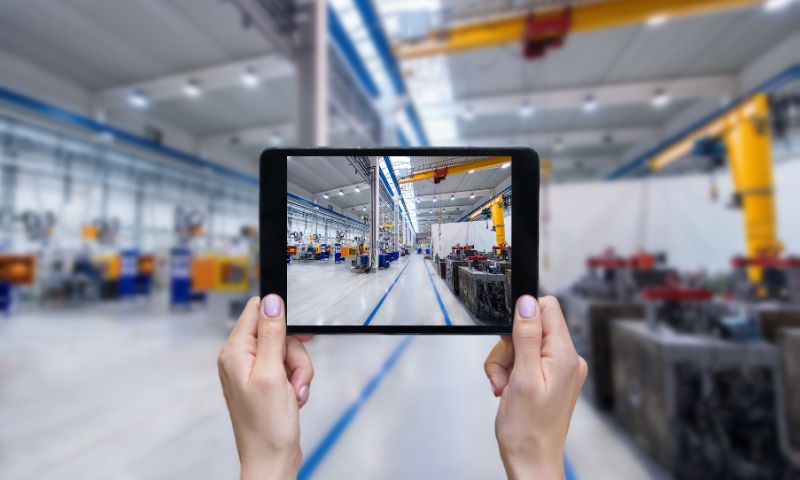
Digital twins are becoming a key foundation for smart manufacturing. By building a virtual factory, manufacturers can simulate production line layouts, verify equipment movements, optimize process planning, and reduce errors, rework, and communication costs before implementation.
However, when companies begin building a digital twin environment, they often face one fundamental challenge: data from different engineering software tools is difficult to integrate.
Mechanical teams may use SolidWorks to design products, automation teams may use Siemens NX to plan production lines, robotic systems may rely on dedicated software to configure motion paths, and factory buildings and utility systems may be modeled in Revit. When these data sources need to be integrated into the same virtual factory, companies often encounter repeated file conversion, broken models, missing signals, and lengthy cross-department coordination.
To break down these data silos, the industrial world is paying increasing attention to OpenUSD, or Universal Scene Description. OpenUSD is not just another 3D file format. It is becoming a key technical foundation that allows different engineering data to be layered, synchronized, and used collaboratively within the same virtual scene.
OpenUSD: A Data Foundation for Digital Twins
When people first hear about OpenUSD, they may think of it as another 3D model format similar to STL, OBJ, or STEP. However, OpenUSD is not designed only to store the external appearance of a model. It is capable of describing much richer scene data and serving as a foundation for digital twin environments.
Compared with traditional 3D formats, OpenUSD is closer to a collaborative 3D scene data framework. In addition to geometry, it can also include materials, physical properties, animation timelines, and logical behaviors. This allows a virtual factory to be more than something that simply “looks like” the real factory. It can become a digital environment that more closely reflects how the factory actually operates.
In other words, the value of OpenUSD does not lie in creating a single model. Its value lies in enabling data from different software tools, departments, and engineering stages to be integrated and continuously updated within the same digital twin environment.
How OpenUSD Solves Industrial Integration Challenges
OpenUSD is valuable not only for creating 3D scenes, but also for keeping different engineering data synchronized and usable within the same digital twin environment.
01
Layering and Composition: Independent Work, Real-Time Integration
OpenUSD uses the concept of layering and composition. Mechanical design, automation control, factory piping, lighting, and other engineering information can exist in separate layers.
For example, mechanical engineers can maintain the original CAD appearance, automation engineers can add PLC signals and motion paths, and facility engineers can include factory environment and utility information. Each team can update its own data layer while the results are integrated and displayed in the same virtual scene.
This approach helps reduce repeated file conversion and the risk of data being overwritten. It also makes cross-department collaboration closer to synchronized updating, instead of requiring teams to re-import the entire model every time a design change occurs.
02
Physics-Based Data: Beyond Visualization
In manufacturing, a digital twin cannot be just a visual presentation. The behavior of equipment, materials, and mechanical movements in the virtual environment must reflect the real world as closely as possible.
OpenUSD can describe physical properties such as mass, density, friction, and elasticity. When combined with physical simulation and rendering environments, it can support the simulation of collision, gravity, and motion behavior. For production line planning, robot path verification, interference checking, and automation implementation, this makes virtual testing more valuable from an engineering perspective.
In other words, OpenUSD does not only help engineering teams “see” the virtual factory. It also enables equipment and objects inside the virtual factory to operate in a way that is closer to the real manufacturing site.
03
Lazy Loading: Supporting Large Factory Models
A smart factory may contain thousands of machines, millions of components, and a large amount of factory piping and utility data. If a system needs to load the entire factory model at once, the hardware load can become very high, making cross-location collaboration difficult.
OpenUSD supports lazy loading, allowing the system to dynamically load only the scene data needed based on the area currently being viewed by the user. This helps reduce hardware load and makes large-scale virtual factories more suitable for engineering review, remote collaboration, and international project meetings.
For manufacturers that need to manage multiple sites, multiple production lines, or large-scale equipment layouts, this capability allows digital twins to move beyond single-machine demonstrations and support broader collaborative applications.
The Value of OpenUSD Goes Beyond Visualization
The value of a digital twin is not simply to build an attractive 3D factory model. The real value lies in integrating engineering design, automation control, equipment information, and on-site data.
OpenUSD provides a more open and collaborative scene data foundation, allowing data from different software tools, departments, and engineering stages to be used in the same virtual environment. For smart manufacturing, this means digital twins can evolve from demonstration-oriented applications into tools for process validation, equipment integration, production line simulation, and virtual-physical collaboration.
When a virtual factory can continuously integrate design data, equipment data, and on-site status, companies can identify planning issues earlier, conduct cross-department discussions more efficiently, and complete more verification work before actual implementation.
Conclusion: Toward Open and Collaborative Digital Twins
In the past, digital twins were often limited to a single software tool or a single department. When data could not be exchanged smoothly, a virtual factory could not truly support cross-department decision-making.
With OpenUSD, digital twins have the potential to become a shared foundation for collaboration across software tools, teams, and factories. For manufacturers, future competitiveness will not depend only on the ability to build 3D models, but on whether models, equipment, processes, and data can be connected to create a smart manufacturing environment that can be continuously updated.