



DATA INTEGRATION × DECISION SUPPORT
Manufacturing Data Platform
and Data Integration Solution
Integrate data from ERP, MES, WMS, IIoT, equipment, databases, cloud services, and files through automated ETL workflows. Collect, transform, organize, and store data in structured layers to build a consistent data foundation for BI, AI, management dashboards, and cross-system enterprise applications.
COMMON CHALLENGES
More Data Sources, Greater Integration and Management Complexity
Manufacturing data is distributed across ERP, MES, WMS, equipment, databases, and files. When reports, BI, AI, and enterprise applications require data from multiple systems, teams must repeatedly extract, prepare, and integrate it, increasing IT workload and ongoing maintenance.
Data Scattered Across Systems
Different systems use different formats, naming conventions, and update cycles, making it difficult to build a consistent, shared data foundation.
Time-Consuming Manual Processing
Teams repeatedly export Excel files, consolidate data, and verify the results. As data volumes grow, processing time and the risk of errors also increase.
Delayed Reports and Insights
Manual data extraction and preparation prevent reports from reflecting the latest production and operational conditions, slowing cross-functional decision-making.
Repeated Integration Effort
New reports, dashboards, AI use cases, and enterprise applications may require additional connections to source systems, increasing development and maintenance effort.
SOLUTION ARCHITECTURE
Build a Unified Data Foundation for Analytics and Enterprise Applications
The Manufacturing Data Platform integrates data from internal and external systems and sources. Automated ETL workflows collect, transform, and organize data, then store it in structured layers based on business needs. This provides a consistent data foundation for BI dashboards, AI analytics, and enterprise applications.
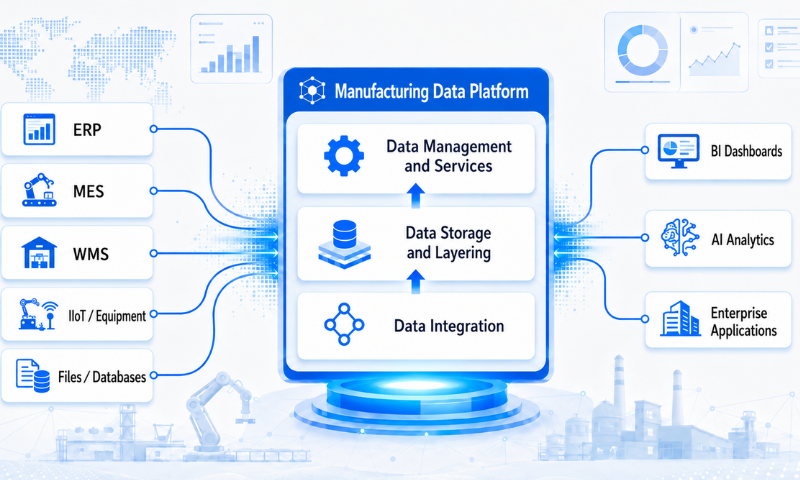

01 Diverse Data Sources
Integrate data from ERP, MES, WMS, IIoT, equipment, databases, cloud services, and files to reduce data fragmentation and improve data sharing across systems.

02 Data Extraction and Integration
Use scheduled ETL workflows to automatically collect, transform, cleanse, and organize data, reducing manual exports and repetitive processing.

03 Data Storage and Layering
Classify and store data in structured layers based on content, subject areas, and application needs, turning raw data into accessible and reusable information.

04 Data Access and Applications
Make integrated data available for BI reports, management dashboards, AI analytics, and cross-system enterprise applications.
IMPLEMENTATION BENEFITS
From Manual Data Processing to Automated Data Delivery
By establishing automated workflows for data collection, preparation, and updates, the Manufacturing Data Platform reduces manual exports and repetitive processing. Prepared data is readily available for reporting, analytics, and cross-system applications.

BEFORE
Manual Processing

AFTER
Automated Workflows
01
Data Acquisition

Data must be manually exported from each system, making data collection time-consuming and delaying data availability.

Scheduled workflows automatically collect and update data, reducing data preparation time.

02

Data Access

Data is scattered across multiple sources, making timely access difficult for reports and applications.
A unified data foundation makes prepared data easier to access and use.

03

Source System Load
Reporting and analytics tools query source systems directly, increasing database and system load.
Once data is ingested into the platform, applications can access it without repeatedly querying source systems.

04

Application Integration
Each report, dashboard, or application requires a separate connection, increasing development and maintenance effort.
Consistent, prepared data accelerates the development and integration of cross-system applications.

 Establish a reliable and scalable data delivery framework that supports reporting, operational decision-making, and cross-system applications.
DATA APPLICATIONS
Extend Integrated Data into Analytics and Decision-Making Applications
The Manufacturing Data Platform collects, transforms, and organizes data from multiple sources to establish a consistent and continuously available data foundation for BI, AI, management dashboards, and cross-system enterprise applications.
 BI and Management Dashboards
Turn cross-system data into reports, KPIs, and visual dashboards for faster visibility into manufacturing and operational performance.
 AI and Advanced Analytics
Provide organized and consistent data for AI modeling, forecasting, and other AI-enabled applications while reducing repeated data preparation.
 Cross-System Enterprise Applications
Use a unified data foundation to support internal systems, web applications, and other enterprise applications while reducing repeated integration work.
API Data Services
Deliver curated platform data to front-end applications and third-party systems through APIs, providing a standardized method for data access and exchange.
IMPLEMENTATION APPROACH
Start with Core Needs and Expand the Data Platform in Phases
As data sources and application needs continue to grow, organizations can begin with clearly defined use cases and key data sources. After establishing and validating the initial data foundation within a manageable scope, the platform can be expanded gradually based on business priorities.
Short Term | Focus on Priorities and Build the Foundation
Identify priority use cases and key data sources. Set up data collection workflows and an initial data foundation to demonstrate value quickly.
Medium Term | Expand Data Sources and Data Applications
Integrate additional systems and data sources. Develop subject-based datasets and cross-functional applications to expand the value of integrated data.
Long Term | Continuously Optimize and Build Data Assets
Continuously refine the data architecture based on operational and decision-making needs. Extend BI, AI, and cross-system applications to turn data into a long-term enterprise asset.
Adopt a phased implementation approach based on business priorities and current needs, without integrating every system at once.
NTT DATA ADVANTAGES
Build a Reliable Manufacturing Data Platform from Planning to Deployment
A successful data platform requires more than technology implementation. It must align with existing systems, data structures, and practical application needs. NTT DATA supports enterprises from roadmap and architecture planning through data integration and application deployment, enabling phased implementation and continuous expansion.
Cross-System Integration Planning
Review data sources across ERP, MES, WMS, IIoT, equipment, databases, cloud services, and files, then design a data flow and integration architecture suited to current business needs.
Manufacturing Data Expertise
Apply experience across production, quality, equipment, warehouse, and operational management to turn fragmented data into a reliable foundation for analytics and enterprise applications.
Phased Implementation and Validation
Prioritize application scenarios and data scope, then implement and validate the platform step by step to reduce complexity and avoid unnecessary rework and investment.
Continuous Support and Optimization
Provide user training, system maintenance, and expansion support to accommodate growing data sources and evolving application requirements.
FAQ
Manufacturing Data Platform FAQs
Does a Manufacturing Data Platform replace existing ERP, MES, or WMS systems?
No. The platform integrates, organizes, and delivers data across systems, while existing ERP, MES, WMS, and other business systems continue to perform their original functions.
Do all systems need to be integrated at once?
No. Enterprises can first prioritize key application scenarios, systems, and data sources for implementation and validation, then gradually expand the integration scope.
What data sources can the platform integrate?
It can integrate data from ERP, MES, WMS, IIoT, manufacturing equipment, databases, cloud services, and files such as Excel and CSV. The appropriate integration method is determined based on each system’s interfaces and data formats.
Is the platform limited to specific ERP or manufacturing system vendors?
No. The platform can integrate systems from different vendors and with different architectures within an enterprise’s existing IT environment. It is not limited to specific ERP, MES, or database products.
How does the platform support BI and AI applications?
The platform collects, transforms, organizes, and stores data in structured layers, creating a consistent and continuously accessible data foundation for BI reports, management dashboards, AI modeling, and AI applications.
How can other systems access data prepared by the platform?
Data can be provided through database queries, file exchange, or APIs based on application requirements. APIs serve as a standardized data service and exchange method for delivering prepared data to front-end applications and third-party systems.
MANDARIN WEBINAR
Manufacturing Data Integration and Data Platform Implementation
Webinar language: Mandarin Chinese
As manufacturing data sources become increasingly diverse, integrating and organizing data across systems has become essential to advancing smart manufacturing.
This webinar introduces how automated ETL workflows collect, transform, and integrate cross-system data to establish a consistent and reusable data foundation. It also explains how the platform supports BI, AI, management dashboards, and cross-system enterprise applications.
GET STARTED
Plan a Manufacturing Data Platform Around Your Business Needs
Whether you need to integrate data from ERP, MES, WMS, IIoT, and equipment, or establish a reliable data foundation for BI, AI, and cross-system applications, NTT DATA can help develop a phased implementation plan based on your current environment and business priorities.