


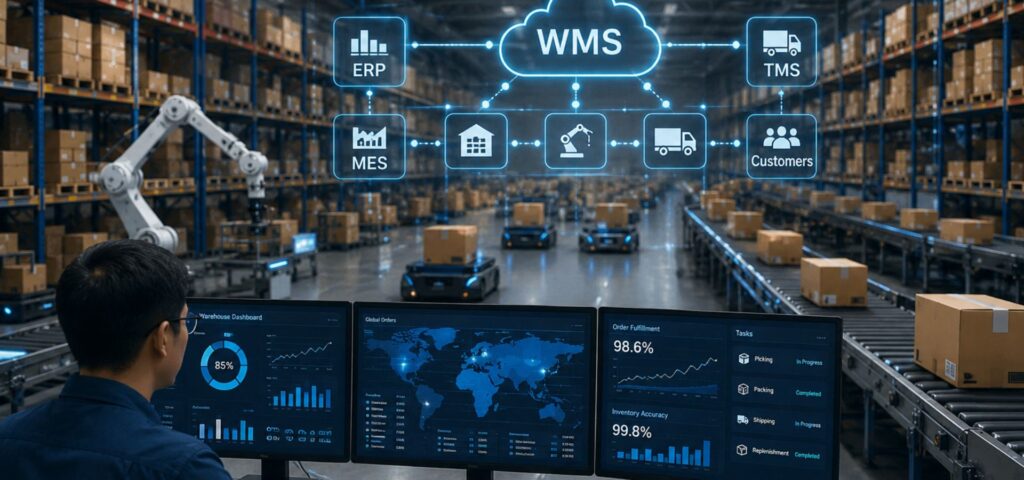
As supply chain volatility, labor shortages, and automation demands continue to increase, warehouse management is evolving from a simple logistics execution function into a critical part of modern supply chain operations.
Modern Warehouse Management Systems (WMS) is no longer limited to inventory management. It now serves as a key platform connecting ERP systems, automation equipment, and warehouse floor operations.
Why Companies Need to Redefine the Role of Warehouse Management?
Amid growing supply chain uncertainty and labor shortages, warehouses are no longer just logistics cost centers. They are becoming a critical factor in operational efficiency and supply chain resilience.
WMS is also evolving beyond inventory and inbound/outbound management. Modern WMS now serves as a key platform connecting ERP systems, automation equipment, and warehouse floor operations.
In the post-pandemic era and under ongoing global supply chain restructuring, companies commonly face challenges such as:
- Unstable production and order demand
- Labor shortages and rising warehouse operation costs
- Lack of synchronization between ERP and automation systems
- Difficulty coordinating AGV, AMR, and WCS operations

Challenges in Modern Warehouse Management

Common Pain Points in Warehouse Operations
Many warehouse operations still rely heavily on manual experience and paper-based processes, resulting in delayed inventory visibility and difficulty measuring operational performance.
As companies introduce ERP, AGV, AMR, and warehouse automation technologies, these issues often become major barriers to digital transformation.
Key challenges include:
- Heavy reliance on manual experience and lack of standardized workflows
- Inventory data not synchronized with ERP
- Lack of unified task allocation and dispatching logic
- Disconnection between automation equipment and core systems
The WMS Maturity Journey
Modern WMS implementation typically evolves through four stages: warehouse digitalization, process standardization, real-time visibility, and intelligent orchestration. These stages help companies build smarter warehouse operations with greater efficiency and decision-making capabilities.
01 Warehouse Digitalization
Digitize warehouse operations and inventory activities
- PDA and barcode operations
- Real-time inventory and transaction updates
- Lot and shelf-life management
02 Process Standardization & Control
Reduce reliance on manual judgment
- Putaway and storage allocation strategies
- Picking process optimization
- Standardized warehouse operation workflows
03 Gain real-time visibility into warehouse operations
Gain full visibility into warehouse operations
- Inventory dashboards
- Operational KPI monitoring
- Inventory turnover and material flow analysis
04 Intelligent Orchestration & Optimization
Enable proactive decision-making through system intelligence
- AI-based route optimization
- Automation integration (AGV/WCS/AMR)
- ERP and MES system integration
By evolving from digitalization to intelligent orchestration, companies can build smarter warehouse management operations with improved inventory control, operational efficiency, and fulfillment quality.
What Business Benefits Can WMS Deliver?
Industry experience shows that companies implementing modern WMS can significantly improve inventory accuracy, picking efficiency, and shipping quality while enhancing overall operational decision-making.
99.8%
Inventory Accuracy
Improve inventory visibility
and reduce discrepancies
30~40%
Picking Efficiency Improvement
Optimize workflows and
reduce manual operations
70%+
Reduction in Shipping Errors
Improve fulfillment accuracy
and customer satisfaction
How WMS Connects ERP and Warehouse Automation?
Modern WMS is more than a warehouse execution system. It serves as a key platform connecting ERP, MES, AGV, and WCS systems, enabling synchronized coordination between orders, inventory, and warehouse equipment operations.
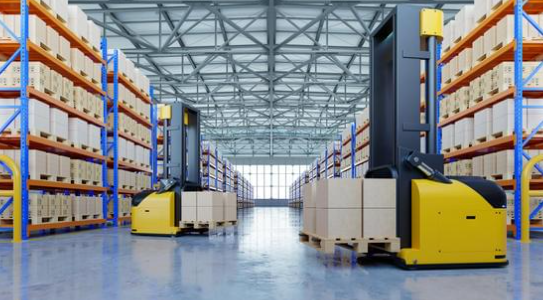
Benefits of ERP Integration
- Synchronization of material codes and storage location data
- Standardized inventory status management
- Real-time feedback for inbound, outbound, and transfer operations
Coordination with Warehouse Automation Systems
- Coordinated operations between WMS, AGV, and AMR
- WCS manages equipment instructions and task control
- AGV and AMR execute transportation and movement tasks
The Future of Smart Warehousing: Toward an Intelligent Supply Chain
Future WMS will combine AI, real-time data analytics, and warehouse automation capabilities to support predictive replenishment, dynamic slotting management, optimized putaway strategies, and cross-system operational coordination.
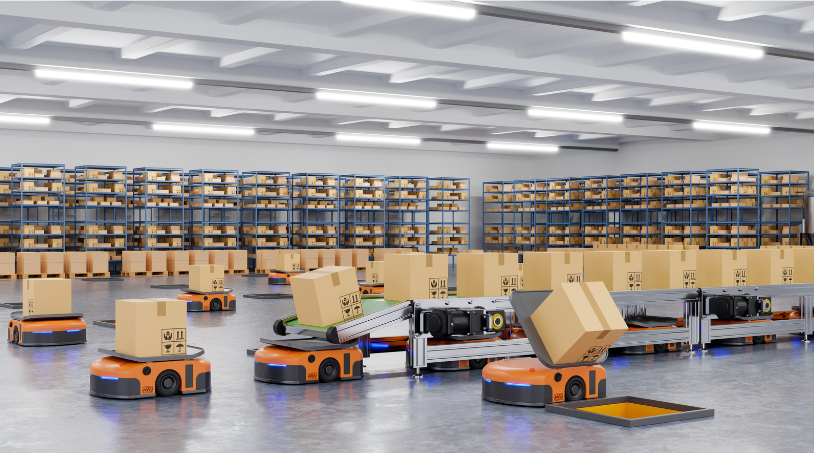
Trends in Intelligent Supply Chain Development
- AI-driven putaway recommendations and route optimization
- Real-time inventory visibility and monitoring
- Predictive maintenance and workforce planning
Recommendations for Enterprise Adoption
- Build a strong foundation through standardization and digitalization
- Enable coordination between ERP, MES, and AGV systems
- Establish measurable KPIs for continuous operational improvement
WMS Is Becoming the Core Platform of Intelligent Supply Chains
Future competitiveness will no longer depend solely on production capacity, but on the ability to respond quickly to demand changes and coordinate operations across multiple systems in real time.
WMS is evolving from a warehouse management tool into a supply chain coordination platform that connects ERP, MES, AGV, and warehouse automation systems, helping companies build more agile, efficient, and data-driven supply chain operations.